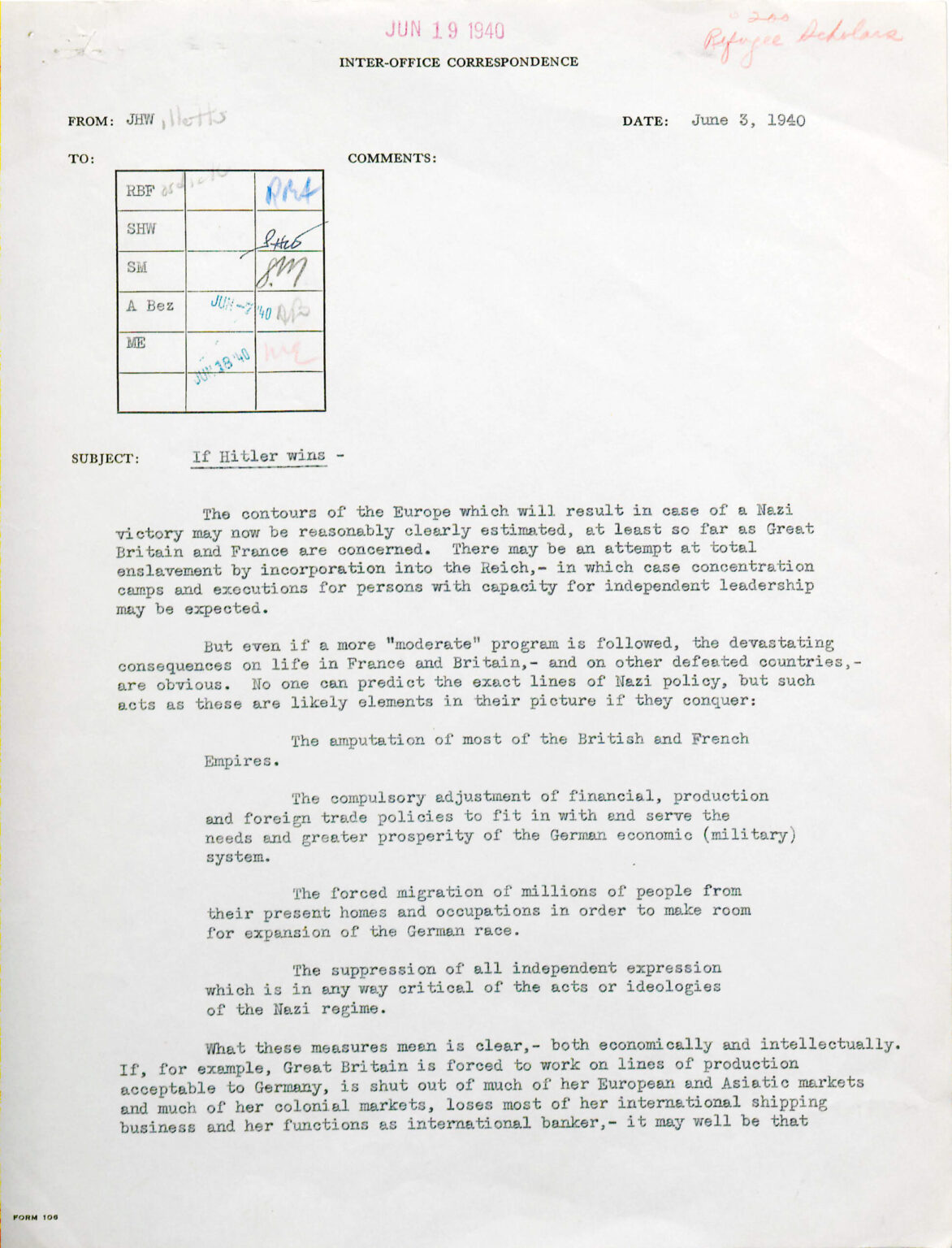
In the 1989 WNET television documentary, the discussion centers on how the Rockefeller Foundation facilitated the importation of “German intellectuals” fleeing the rise of the NSDAP. In reality, many of these individuals were Jewish intellectuals whose activities were viewed as subversive to the German nation. A central component of this migration was the transfer of scholars from the Institut für Sozialforschung (the University of Frankfurt’s Institute for Social Research), who entered the United States under the Rockefeller Foundation’s Refugee Scholar Program. The arrival of these predominantly Jewish academics would ultimately exert one of the most significant transformative effects on the nature and character of American academia and culture.
This program involved the importation of several notable Marxist theorists such as: Max Horkheimer, Theodor Adorno, Walter Benjamin, Erich Fromm, Wilhelm Reich, Herbert Marcuse.
The first program for refugee scholars was initiated in 1933 as the Special Research Aid Fund for Deposed Scholars. This fund set aside money for educational or research institutions in Europe and the United States that were willing to employ scholars who had lost their former positions for religious or political reasons. RF funding typically provided half the cost of a scholar’s salary. This program operated until 1939, aiding mainly German academics. Many notable scholars, including physicist Leo Szilard and novelist Thomas Mann, were assisted under this program. While aid for deposed scholars continued until 1945, by 1940 the rate of funding was slowed when the Emergency Program for European Scholars began.
This initiative was justified publicly on the grounds that the “Nazis” were suppressing and destroying legitimate intellectual inquiry. However, the evidence suggests that these scholars were advancing ideas and ideological frameworks regarded by German authorities as detrimental to national social cohesion. Many were committed Marxist theorists. When they realized that the economic doctrines of communism were unlikely to gain traction in a prosperous United States, they sought alternative avenues through which to disseminate their ideas. Their work increasingly focused on developing methods for translating the principles and values of communism into cultural critique, exploiting mass media and the troubled nature of America’s racial dynamics. From the perspective of a government concerned with preserving the cultural integrity, identity, and social values of the nation, these men appeared as ideological adversaries committed to its destabilization.
With millions of people having to or desiring to migrate from their homelands, the pressure on the Foundation to become a relief body will be terrific. I suggest, – at least so far as SS [Social Sciences] is concerned, – that we choose now as the small part of the total task which the Foundation’s limited resources permit it to undertake, the responsibility for relocating such of the best of the scientific and scholarly men and women from France, Great Britain and other over-run countries as may be available to leave.
- Joseph H. Willits, “If Hitler Wins,” June 3, 1940